
Student Resources
AI Tips
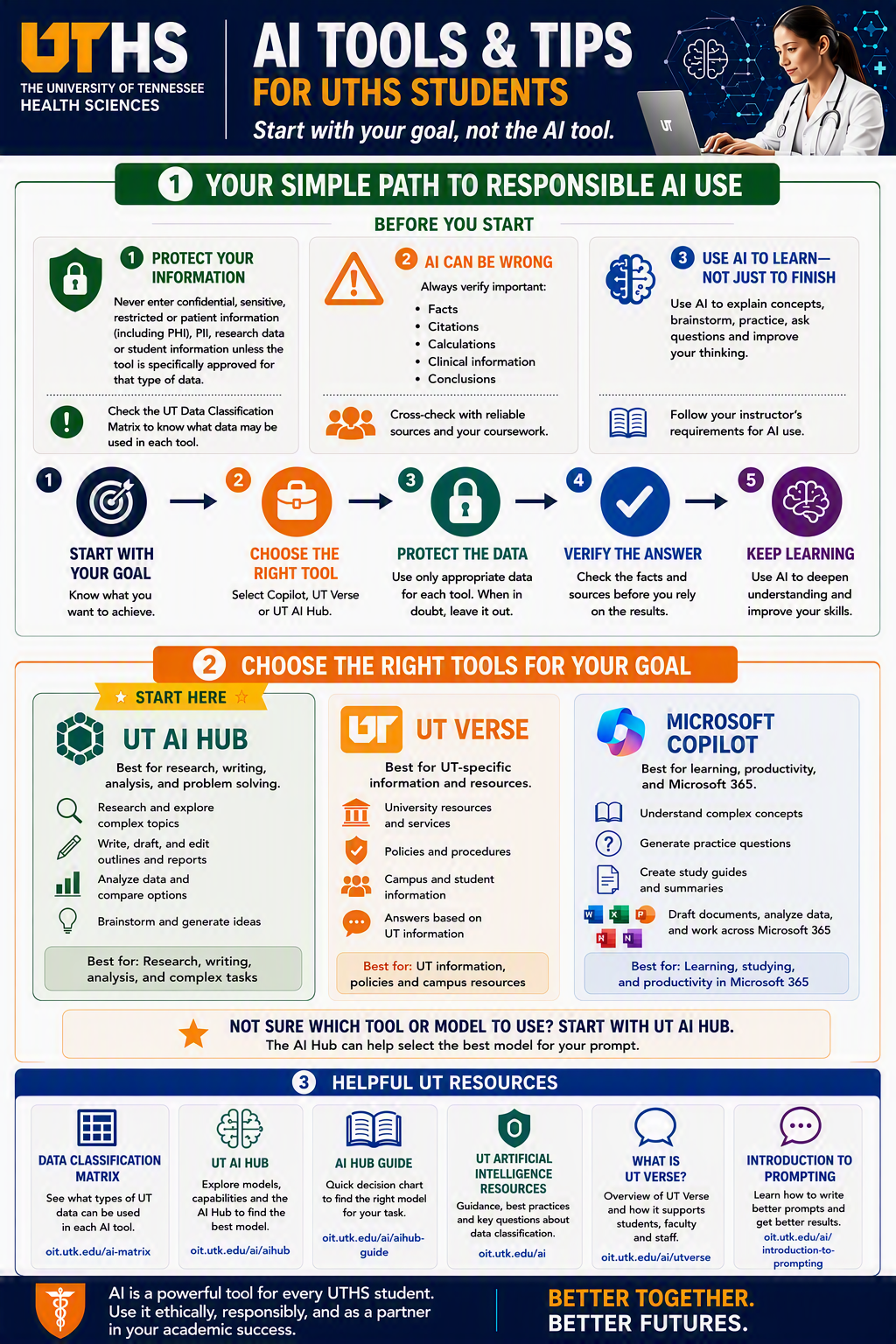
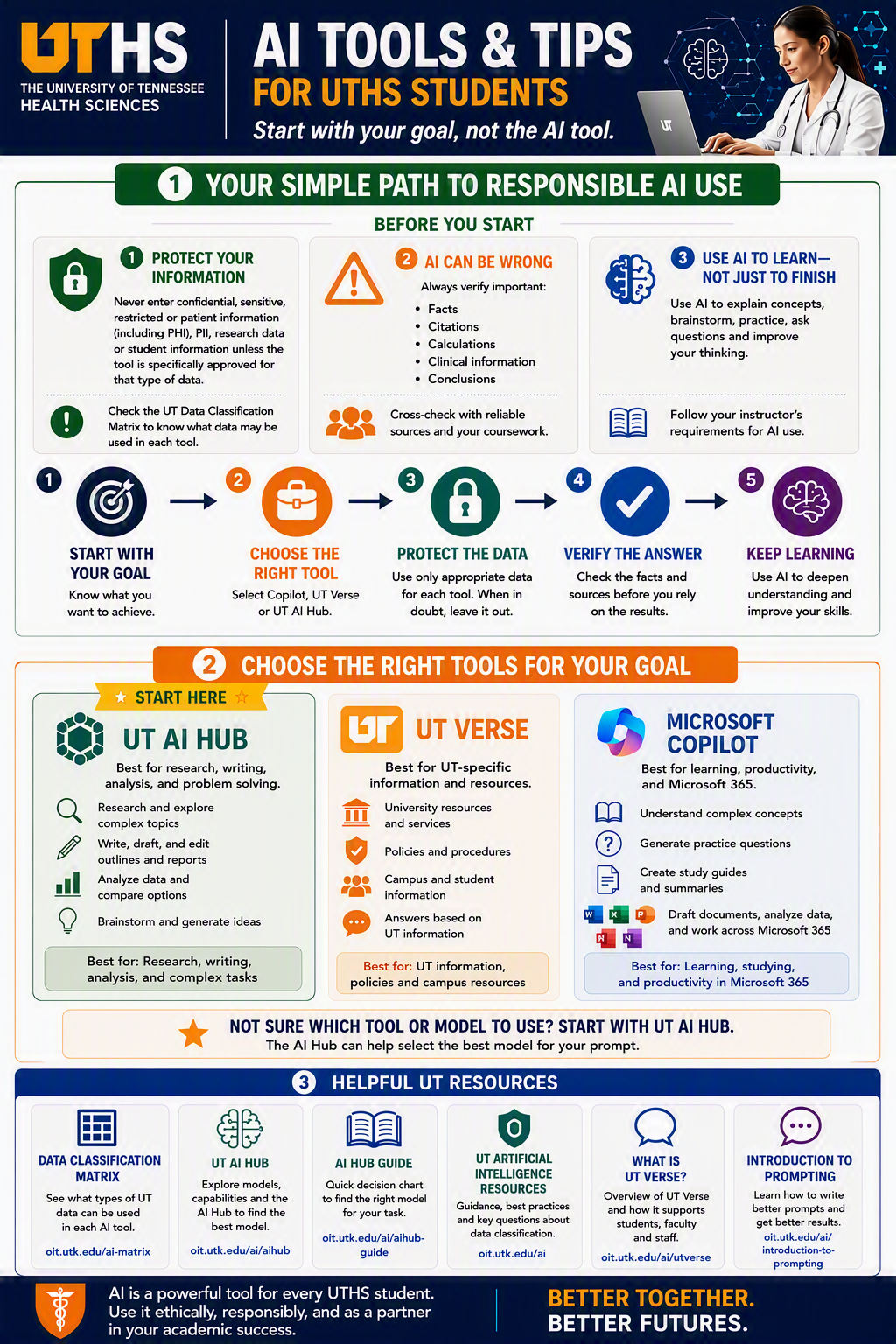
Artificial intelligence can help with studying, writing, research, brainstorming, and productivity. To use AI effectively, start with your goal rather than choosing a tool first. Select the tool that best matches your task, verify AI-generated information, and follow university guidance regarding privacy, security, and academic integrity.
Your Simple Path to Responsible AI Use
Before using any AI tool, keep these principles in mind:
Protect Your Information
Never enter confidential, sensitive, restricted or patient information (including PHI), PIl, research data or student information unless the tool is specifically approved for that type of data.
AI Can Be Wrong
AI-generated content may contain mistakes.
Always verify:
- Facts
- Citations
- Calculations
- Clinical information
- Conclusions
Cross-check important information using reliable sources and course materials.
Use AI to Learn, Not Just to Finish
AI works best as a learning partner.
Use AI to:
- Understand concepts
- Brainstorm ideas
- Practice knowledge and skills
- Ask questions
- Improve critical thinking
Always follow your instructor's expectations for AI use in coursework.
Five Steps for Responsible AI Use
- Start with Your Goal
Define what you are trying to accomplish before selecting a tool. - Choose the Right Tool
Select the AI platform that best fits your needs. - Protect the Data
Only use appropriate information in AI tools. - Verify the Answer
Check facts, sources, and important details before relying on AI output - Keep Learning
Use AI to deepen understanding and build skills over time.
Choose the Right Tool for Your Goal
UT AI Hub
UT AI Hub is best for: research, writing, analysis, and complex problem solving
Use AI Hub when you need to:
- Explore complex topics
- Research and compare options
- Draft and edit reports or outlines
- Analyze information
- Brainstorm ideas
Recommended starting point: If you are unsure which AI tool or model to use, begin with AI Hub.
UT Verse
UT Verse is best for: UT-specific information and campus resources
Use UT Verse when you need:
- University resources and services
- Policies and procedures
- Campus and student information
- Answers based on UT information
Microsoft Copilot
Microsoft Copilot is best for: learning, studying, productivity, and Microsoft 365
Use Copilot when you want to:
- Understand difficult concepts
- Generate practice questions
- Create study guides and summaries
- Draft documents
- Work within Microsoft 365 applications
- Helpful UTHS AI Resources
Helpful UT Resources
UT Data Classification Matrix: Learn what types of university data may be used with different AI tools.
UT AI Hub: Explore AI models, capabilities, and tools available through the university.
AI Hub Guide: Use a decision guide to help select the right AI tool for your task.
UT Artificial Intelligence Resources: Review university AI guidance, best practices, and frequently asked questions.
What Is UT Verse?: Learn how UT Verse supports students, faculty, and staff with university-focused assistance.
Introduction to Prompting: Learn how to write more effective prompts and improve AI-generated responses.
Remember
AI is a powerful tool, but it should be used responsibly. Protect sensitive information, verify important information, think critically about AI-generated responses, and remain responsible for your own academic work and decisions.
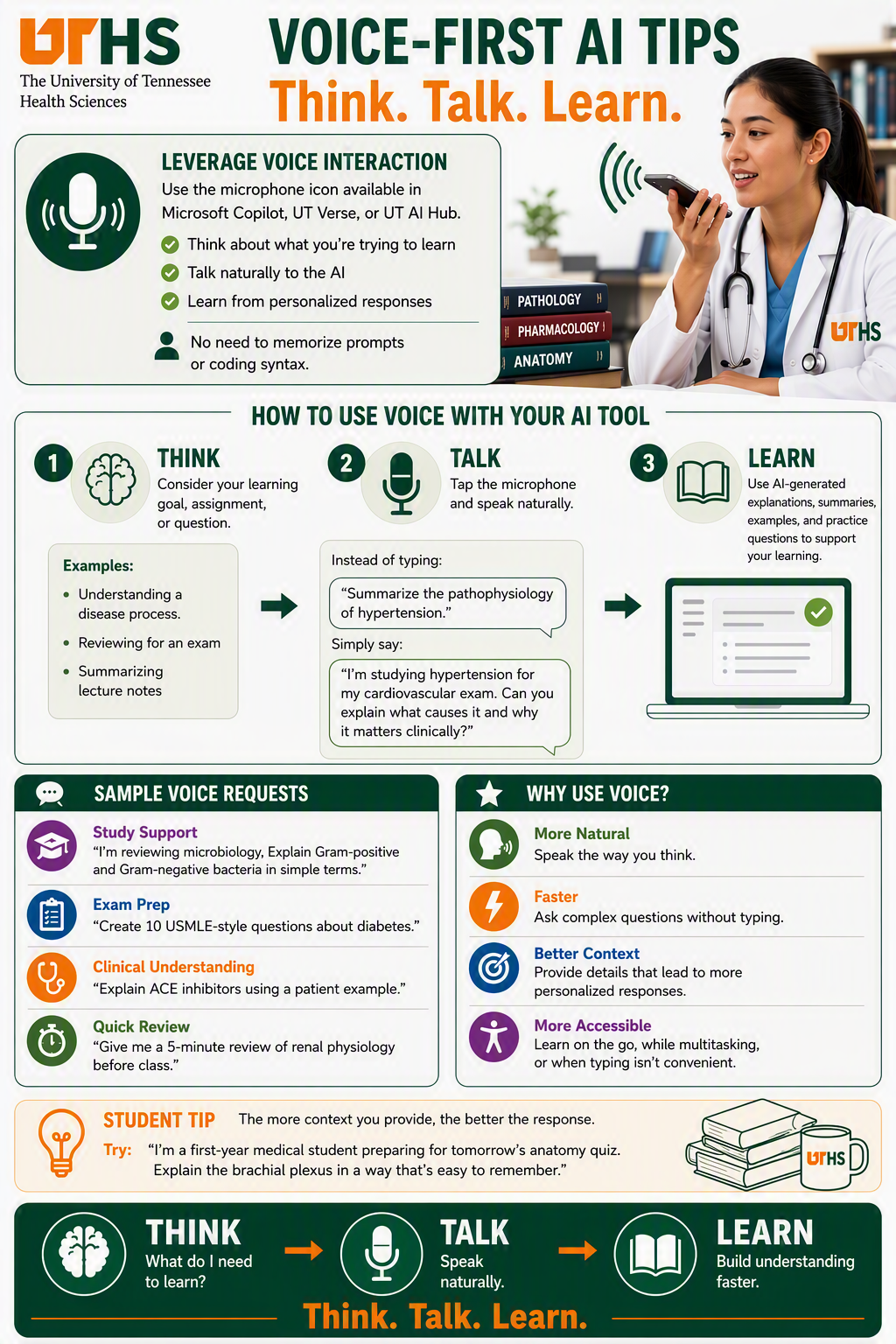
Voice-First AI Tips: Think. Talk. Learn.
Voice-enabled AI tools allow you to interact naturally using speech instead of typing. Whether you are studying, preparing for an exam, reviewing course materials, or exploring a new topic, voice interaction can help you learn more efficiently.
Leverage Voice Interaction
Use the microphone feature available in tools such as Microsoft Copilot, UT Verse, and UT AI Hub.
Voice-first AI can help you:
- Think about what you want to learn
- Speak naturally to ask questions
- Receive personalized explanations and responses
- Learn without needing to memorize prompts or coding syntax
How to Use Voice with Your AI Tool
Step 1: Think
Before speaking, consider your learning goal, assignment, or question.
Examples include:
- Understanding a disease process
- Reviewing for an upcoming exam
- Summarizing lecture notes
- Exploring a clinical concept
- Clarifying difficult course material
Step 2: Talk
Tap the microphone icon and speak naturally.
Instead of Typing
Summarize the pathophysiology of hypertension.
Try Saying
I'm studying hypertension for my cardiovascular exam. Can you explain what causes
it and why it matters clinically?
Providing context helps AI generate more relevant and useful responses.
Step 3: Learn
Use AI-generated content to support your learning by requesting:
- Explanations
- Summaries
- Practice questions
- Examples
- Review materials
- Study guides
Remember to evaluate information critically and consult course materials and instructors when appropriate.
Sample Voice Requests
Study Support
I'm reviewing microbiology. Explain Gram-positive and Gram-negative bacteria in simple terms.
Exam Preparation
Create 10 USMLE-style questions about diabetes.
Clinical Understanding
Explain ACE inhibitors using a patient example.
Quick Review
Give me a five-minute review of renal physiology before class.
Why Use Voice?
More Natural
Speak the way you think. Voice interaction can feel more conversational and intuitive than typing.
Faster
Ask complex or detailed questions without spending time typing long prompts.
Better Context
Providing details verbally often leads to richer, more personalized responses.
More Accessible
Voice tools can support learners who prefer speaking, are multitasking, or find typing inconvenient.
Student Tip
The more context you provide, the better the response.
Example
I'm a first-year medical student preparing for tomorrow's anatomy quiz. Explain the brachial plexus in a way that's easy to remember.
This type of request helps AI tailor explanations to your knowledge level and learning needs.
Key Takeaway
Think. Talk. Learn.
- Think about what you need to learn.
- Talk naturally using the microphone feature available in your AI tool.
- Learn through personalized explanations, examples, and practice materials.
Remember
Voice-first AI can help make studying, reviewing, and learning more efficient by allowing you to engage with technology in a natural, conversational way.
AI Tools
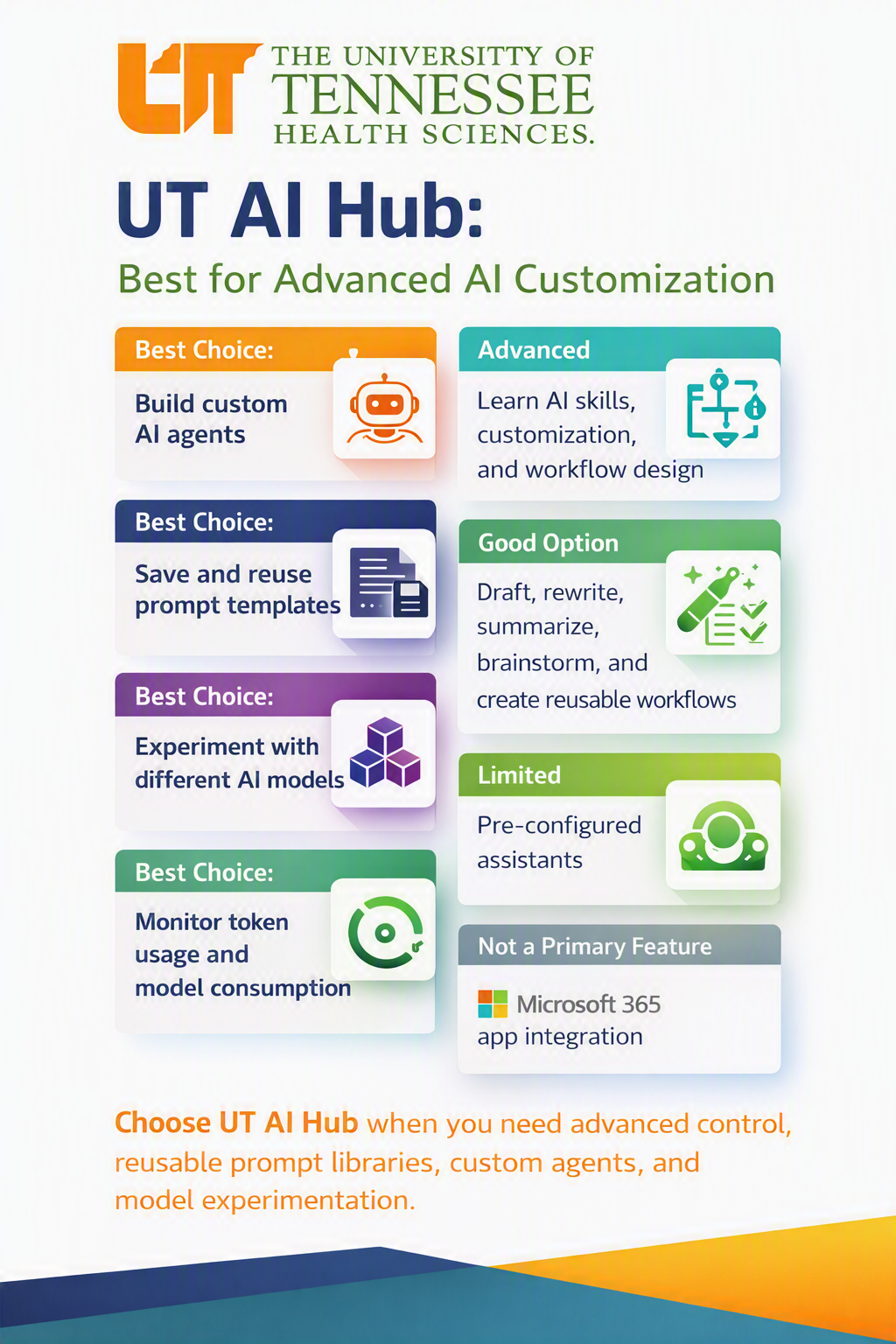
UT AI Hub is designed for users who want greater control over how they use artificial intelligence. It is the recommended platform for building custom AI solutions, creating reusable workflows, and experimenting with different AI models.
Best Uses for UT AI Hub
- Build custom AI agents tailored to specific tasks or workflows.
- Save and reuse prompt templates to improve consistency and efficiency.
- Experiment with different AI models to find the best fit for your needs.
- Monitor token usage and model consumption to better manage resources.
Advanced Capabilities
UT AI Hub supports:
- AI skill development and customization
- Workflow design and automation
- Content drafting, rewriting, summarization, and brainstorming
- Creation of reusable workflows and prompt libraries
Considerations
UT AI Hub includes some pre-configured assistants, but this is not its primary focus. Users seeking extensive Microsoft 365 application integration may find other AI tools better suited to those specific tasks.
When to Choose UT AI Hub
Choose UT AI Hub when you need:
- Advanced AI customization
- Custom AI agents
- Reusable prompt libraries
- Workflow automation
- AI model experimentation
- Usage and consumption monitoring
Remember
UT AI Hub is ideal for power users, educators, researchers, and staff who want to move beyond basic AI interactions and create more tailored, repeatable AI-powered solutions.